There is a long-standing, widely acknowledged, European notion in which responsibility is seen to have an expiration date. Where past deeds, and heinous acts are no longer relevant to contemporary society. Former provinces, and people’s once free from imperial yoke must not look to the activities of past occupiers as a source of contemporary problems. When this expiration day arrives the formerly conquered must look to themselves of the land is not the utopia freedom promised. Wounds must heal, crops must grow, cruelty must end, rape must cease, democracy must flourish, corruption must dissipate, pride must reappear, racial self-loathing must disappear, commerce must appear, and enmity toward one’s former conqueror must be forever banished. Hochschild calls this the ‘politics of forgetting’, a political art in which the west specialises.
Yet, as stated, this is a notion not a fact. Those who have been raped, whipped, murdered, flayed, plundered, psychologically tormented, mutilated, sacked, conquered, have a right to continue their grievance until the end of time if they so wish. It is a time-honoured right that the griever recovers not on the schedule of the any who induced them to grieve, but according to the emotional time-frame the mind creates.
So, to the forgetful inducers of grief, Belgium, and its royal family, heirs of King Leopold II.
Behind the fragrant waffles, imaginative chocolates, and majestic architecture Belgium has a seedy past which is often ignored; the Congo. When death takes place on such a scale, without official numbers, scholars use categories to calculate the scale of death. Beneath Belgian rule was a reign of terror in which death was spread over four gruesome categories: murder; starvation, exhaustion and exposure; disease; and falling birth rate; we are reliably informed that there was an ‘abundance’ of each.
Historians estimate that between 1880 and 1920 the Congolese population was cut by half. That is the death of ten million people in forty years; little wonder the numbers are so shamefully high with district commanders offering those within locales ‘absolute submission or complete extermination.’ It seems even with absolute submission an attempt was made to completely exterminate. The figure of ten million does not include those men mutilated, children maimed, women raped and towns tyrannized throughout what can only be called a ‘reign of terror’.
Why? It is reasonable to ask. For surely imperialism took place without such a gargantuan number of deaths. In short, half the populous of the Congo perished for rubber.
A conservative estimate of the wealth made by Leopold alone is $1.1 billion.
The Royal Museum for Central Africa is home to one of the world largest African collections. A plaque which lists the names of several dozen Force Publique officers who ‘rest in African earth’. Hundreds more plaques throughout name white ‘pioneers’ who perished in Africa. Spears, arrows, masks, musical instruments, costumes, drums, and stuffed animals of the African hinterlands fill the collection of stolen goods.
Surely it is bad enough to have a contrite knowing silence, but this is a celebratory silence which does everything but utter the words ‘We raped Africa, and her people, and by Jove look what wonders we got in exchange!’
What of the grievers? Ten million Africans who perished in a holocaust. What of the systematic slave labour system? Where is that commemorated? What of the estimated $1 billion which Leopold himself received from Africa’s soil? Where is that recognized? What of the severed hands of the Congolese men, women, and children? Shall that not be remembered?
Nay, of course not, and why should they be?
Would it not dull the vibrancy of Belgium? Would it not remind those who lounged in sumptuous public squares that their pleasure was provided by the Butcher of Congo? Would it not sour the wondrous taste of the chocolate? Would it be not too potent a reminded that the beauty of Belgium was paid for by a regime guilty of wanton savagery, mass rape, and genocidal murder, blatant slavery and pillaging hitherto unseen?
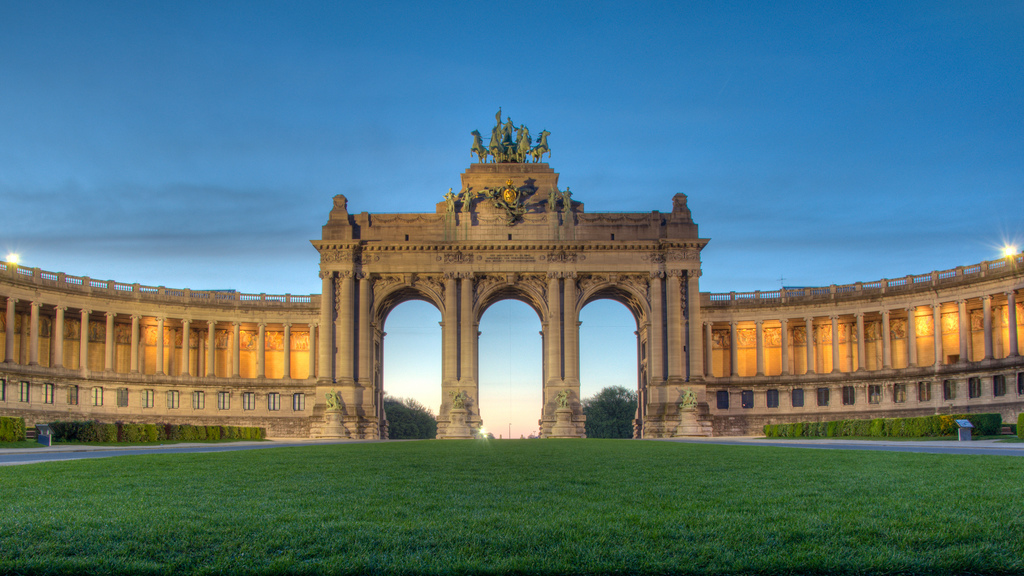
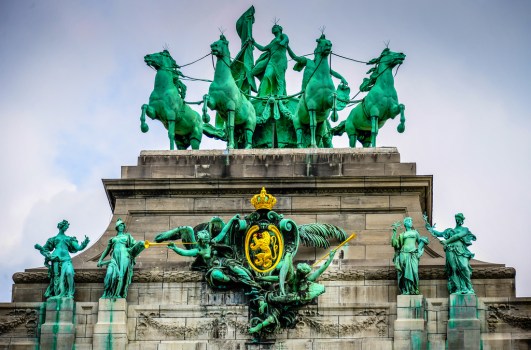
The monarchy is Belgium still exists, still lives in luxury paid for by African blood, still resides in residences paid for and renovated by African wealth, and still have made no contrition in any form. The sumptuous royal palace, with it undulating columns, renovated with Congo money still stands. The chateau of Laeken, favourite residence of Leopold I, renovated with Congolese profits, famed greenhouses still inspiring awe, still stands. The imposing Cinquantenaire arch, which Hochschild has called the ‘grandest Congo-financed extravagance of all’, with its perfectly symmetrical colonnades surrounding what is a monumental structure, still stands.
Why, I hear many ask, should the contemporary Belgian royals give a fig about the crimes of their great-great-grandfather? Well, if they care not for his crimes, they should care even less for his criminal proceeds and vacate all royal residences funded by the Congo butchery, which is indeed all, with haste. Furthermore, the fifty million franks given to Leopold by the Belgian government as ‘gratitude for his great sacrifices made for the Congo’, which were to be ‘extracted From the Congo itself’, should be extracted from the family which benefitted.
Those who commit acts society deems criminal are not able to walk effortlessly away with ill-gotten gains. They are forced to compensate the victims, even if that encompasses bankruptcy. Yet, for the crowned heads of western Europe and their governments these rules do not stand. While persecuting those who committed ‘historical crimes’ in their country, their own historical crimes abroad are buried so deep in the annals they are forgotten by all.
Some will say that in response to the ‘politics of forgetting’, the ‘politics of envy’ begins to hold sway as the ‘unfortunate’ look upon the fortune of the ‘fortunate’ and seek to deprive them of that which they have. Matters little that the ‘fortunate’ are thus only by plundering the less fortunate.
Yet, China, a nation which can no longer be considered ‘unfortunate’ continues to demand their plundered artefacts be returned. Taken at a time when the nation was upon an unending list of nations plundered by the West, China’s status has since risen inexorably.
Their demands are now taken extremely seriously by nations who respect only military and economic power. With an arsenal to compete with any found in the west, and an economy out performing any in the west, China can no longer be bullied nor ignored. Thus, the return of ancient Chinese artefacts by western government is certainly noteworthy. For it shows that the politics of forgetting is purely political, and memories are soon jogged when faced with a nation wealthy and armed.
Of course, Belgium was not unique in its plunder of Africa, not in its systematic brutality of the indigenous. Neither is it in its shameless flaunting. Spain, Germany, France, Portugal, Italy, Austria, and particularly England are all guilty of the dual crime of plunder and parade. The British Museum, while bearing testament to British imperial reach of yesteryear, also lays bare the extent of her own pluderous past.
The difference between reparation and compensation is clear. Where there is irrefutable evidence of goods, art, or minerals taken without the consent of the government of the day, they quite clearly should be returned. As with the plundered Chinese art, and the fifty million ‘extracted’ from the Congo. The ICC (International Criminal Court) restricts itself to only a few contemporary African despots. Yet, it is clear that there is a need for an international arbitrator with a purview to include the criminality, which has taken place in Africa and Asia, where the politics of forgetting has obscured historical crimes. The conflicts between nations which have plundered and nations which have been robbed is evidence that it is not the perpetrator, but the victim who decides the length of time he wishes to grieve for. Thus, the grieving Chinese should not have to wrangle with their plunderer until they are rewarded with the return of their ancient national artefacts. Historical scholars have long unveiled the scale of looting which took place by the colonial powers; revealing figures, places, names, dates, conversion rates, and a host of other revealing facts.
What prevents an International Compensatory Court (ICC ironically) from being established, the world’s foremost scholars presenting it with evidence, a body of esteem legal minds considering all evidence available, and presenting the disputing nations with a legal binding, impartial, verdict? In a word, power. China is an anomaly. The majority of grieving nations have not risen to the heights which allows them to look upon former plunderers with a sense of equality. The Democratic Republic of the Congo is the greatest example. Unable to feed its own citizens, drag itself out of the depths of civil war, or even hold an election free of blatant corruption; Congolese diplomats are in no fit state to look their counterparts in the face, let alone negotiate a compensation package with the savvy Brussels elite.
For the lions have always encircled the weak and shall continue to until the end of time in differing forms. Thus, power must be assumed by the courts which have the ability to protect, empower, and compensate the weak.


Leave a Reply