 The phrase ‘strong man’ is often associated with African tyrants who rule over a cowed populous. 2017 has seen the fall of Yahya Jammeh, President of Gambia for twenty-one years. Facing the threat of military action, he was forced from government after losing an election, accepting the result, then days later deciding the election result did not suit him after all. Jammeh concluded a settlement of $50 million would suffice and duly plundered his country before sailing into affluent exile. Teodoro Obiang Nguema Mbasogo, described as a ‘brutal African dictator’, at seventy-five years old continues to rule Equatorial Guinea. Despite 76.8% of the population living in poverty, the president’s son was recently relieved of $71 million worth of assets by the US government in a trail which threatens to further expose corruption. José Eduardo dos Santos, president of Angola, a despot who stays ever close to the shadows, has ruled for thirty-eight years. His reign, despite praise received for economic endeavours, is shrouded with human rights abuses, cronyism, and bribing political figures with state resources.
Omar Hassan Ahmad al-Bashir, seventy-three years old, has ruled war-torn Sudan for twenty-seven years in which the indigenous populous has seen freedom eroded. Pursed by the International Criminal Court on charges of genocide, seemingly a continental pastime, al-Bashir has presided over an ethnic war in Darfur which has seen millions displaced, hundreds of thousands murdered, thousands tortured, and hundreds killed by chemicals weapons. Yoweri Kaguta Museveni, seventy-three-year-old President of Uganda, has for thirty-one years ensured the suppression of political opposition, democratic freedoms, freedom of speech, human rights, and civil liberties. One of many activists to be imprisoned, academic Stella Nyanzi, was jailed earlier this year for referring to the president as ‘empty brained.’ Jacob Zuma, though neither as long a serving president nor indeed a strong man (the ANC have ruled since independence however), deserves a place upon the list of tyrannical ignominy. For during his tenure South Africa has diminished not only in the eyes of the world but in those of its own citizens who reside in a land with rising levels of poverty, inequality, hunger, political disillusionment, and political corruption. Students protest upon the streets, political opposition are thrown from parliament, the president uses state money to build a lavish compound, and all the while on average the heirs to the inheritance of Mandela coeur de lion live on $1.90 a day.
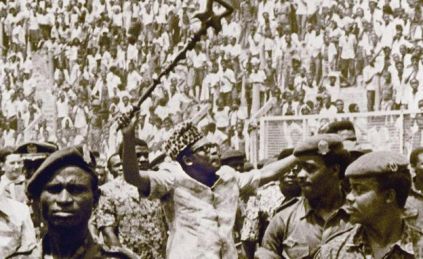
Little wonder then, that in Zimbabwe Robert Mugabe, at the grand age of ninety-three, embarks upon a ‘speaking tour’ of the country as he seeks re-election to the presidency.
For in Africa, like nowhere else, the old and tyrannical are given a stage upon which to perform. And perform they do, more often than not, with ghastly incompetence, extempore genocide, and unabashed cronyism.
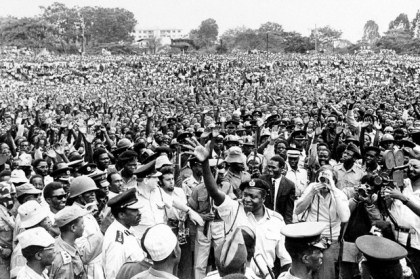
Like no other Mugabe seems to embody all that is wrong with contemporary Africa. The tyrant celebrates his birthday as if a Caesar with national celebrations, opulent surroundings, servile ministers offering repulsive genuflection, and harmonious children shanghaied into singing in festivities which reportedly cost $2 million.
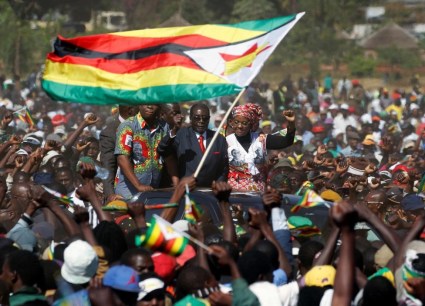
Yet, if Mugabe is a Caesar and Grace a Livia, where exactly is the grandeur that was Rome? Tis certainly not to be found in Zimbabwe! It’s as if the tyrant forgets he rules not a great power, with a sprawling empire, as a mighty Caesar, but governs a small poverty-stricken nation, with a poverty count ratio of 72%[1], as a petty despot. The recent flood that swept through Zimbabwe saw 246 people killed, thousands displaced, and hundreds ‘marooned’ according to the government. Mugabe’s government was forced to plead for $100 from charitable bodies and governments to ease the crisis, a humbling request for a tyrant who prides himself on being the scourge of intervening western (white) governments. Yet, this is a man who takes no pride in presiding over a country which has well feed, well educated, and well protected (black) citizens. For this is not a matter of colour, nor race, tyranny and poor governance transcend such boundaries; thus, it is the men themselves which must be scrutinized.
Nor is it just men. The tyrant’s wife, Grace Mugabe, has shown herself to be a woman of little grace indeed, and an unworthy heir to noble Sally. Referred to a ‘mother’ by Zanu-PF members, her place at the centre of power is such that she is being touted to next adorn the inconsequential crown. Yet, seldom are wives bound to tyrants without acquiring a whiff of despotism; and ‘mother’s’ tyrannical scent has begun to acquire the stench of permanency. After presiding over such scandalous decrease in living standards, she asks ‘why should I not become president?’ Clearly this is a woman who, like her despotic husband, is losing her mental faculties. A government minister was hauled before the courts of law facing the charge of a ‘criminal insult’, for daring to refer to Grace as a ‘fool.’ Renowned for her lavish shopping sprees, reportedly spending $75,000 in a Parisian spree which lasted only hours. This, lest we forget, is a politician of a country with 4.1 million ‘food-insecure’ people in the lean season,[2] 63% of citizens living beneath the poverty line,[3] 27% of children with stunted growth,[4] and with numerous western global organisations providing support for starving citizens. An estimated 1.4 million people living with aids, including an estimated 77,000 children.[5]
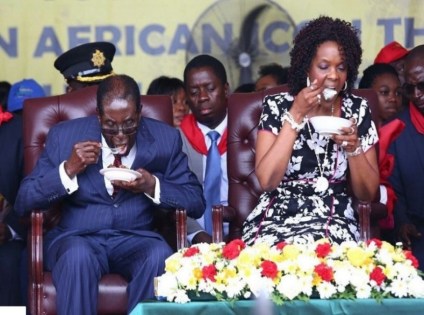
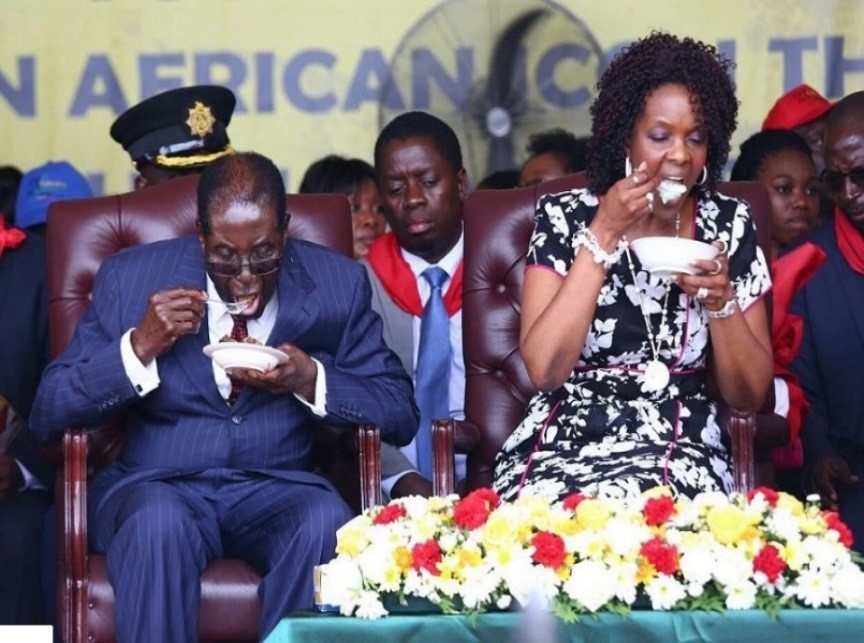
The mantra seems to be, the people starve, ‘let them eat cake.’ The last tyrant’s wife associated with such sentiments faced a grizzly fate. One wonders if the people have the same in store for Grace and Robert as they did for Marie and Louis XVI.
Augustine once damningly remarked that there had been, after all, slaves in ancient Rome which lived in better conditions than the toiling working classes of industrial Britain. I write with equal apathy that there were slaves in ancient Rome, subjects in Victorian Britain, and collaborators in colonial Rhodesia who lived in better conditions than the working poor of free Zimbabwe. What makes the reigns of African strong-men so repulsive is that the memory of nefarious colonial rule still lingers in the memory, and the dawn of independence was imbued with the hope of freedom. How wrong the people were!
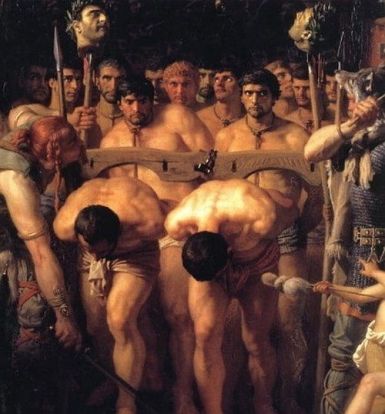
White tyrants have been exchanged for black despots, European cruelty for African perfidy, plundering colonial governments for corrupt national assemblies, villainous white masters for psychotic black henchmen, the stinging masters whip for the enforcers deadly gun, and nefarious European conferences for the posturing African Union. The people remain in bondage; hunger and pestilence still stalk the land, government continues to embezzle, and hired men still murder the innocent.
Yet, Africa is free.
Everything has changed, and nothing has altered. Oh, what a fate.
[1] (The World Bank , 2017)
[2] (World Food Program , 2017)
[3] (World Food Program , 2017)
[4] (World Food Program , 2017)
[5] (UN Aids , 2017)


Leave a Reply