‘This earth of majesty, this seat of Mars,
This other Eden, demi-paradise,
This fortress built by Nature for herself.’
William Shakespeare
There are 54 countries in Africa which is considered the second largest continent. There are 48 countries in Asia which is considered the largest content. There are 44 countries in Europe which is considered the sixth largest continent. There are 35 countries in the Americas – North America is the third largest continent, and South America the fourth. Calculated separately, the continents are connected by a narrow island. For the purpose of this paper Antarctica and Australia require no mention.
According to Country Cassette, a data collection database, when ranking continents by GDP Africa ranks fifth. The second largest continent ranks behind Asia in first, North America in second, Europe in third and South American in forth. It is interesting to note that juxtaposed against size, North America moves up one position, Europe three and those that fall are South America by one and Africa by three positions. Africa’s collective GDP is a mere 2.9% of the global pie, while Asia have a slice of 40.9%. Country Cassette informs us that ‘The African economy, comprising 54 economies, in 2022 is projected around US$2.96 trillion in nominal terms, $200 billion more than 2021, calculated by taking figures from the IMF. This is $476 billion less than United Kingdom GDP, the 6th largest economy in the world.’ For the entire continent of Africa to pale in comparison to the United Kingdom in GDP is startling and a stark reminder of the progress required to close the gap on leading nations. Of the fifty-four nations of Africa, there are four in the top fifty countries and none in the top twenty.
In comparing the natural resources available in Africa to the economic performance of the continent, World Atlas surmised ‘Africa has the richest concentration of natural resources such as oil, copper, diamonds, bauxite, lithium, gold, hardwood forests, and tropical fruits. It is estimated that 30% of the earth’s mineral resources are found in the African continent. Additionally, Africa has the world’s biggest precious metal reserves on earth. Despite the wealth of natural resources, Africa still lags behind in development due to corruption and resource mismanagement.’
The UN Environment Programme, echoing this scathing assessment of the continent, concluded that ‘Africa is home to some 30 percent of the world’s mineral reserves, eight per cent of the world’s natural Gas and 12 percent of the world’s oil reserves. The continent has 40 percent of the world’s gold and up to 90 percent of its chromium and platinum. The largest reserves of cobalt, diamonds, platinum and uranium in the world are in Africa. It holds 65 per cent of the world’s arable land and ten percent of the planet’s internal renewable freshwater source.’ As surprising as the dire nature of the African economy can seem, the scale of the superiority in natural resources is a well-established fact that all are aware of.
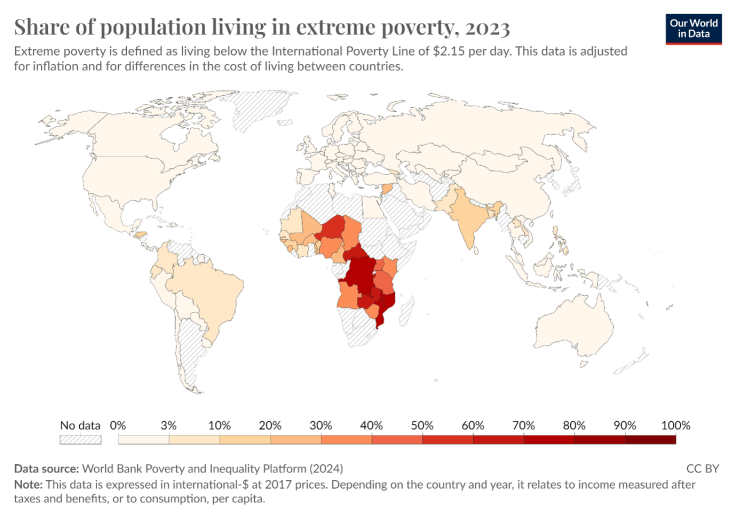
With the richest and second largest continent so economically insignificant, the governance of Africa then must be assessed. In 2015 United Nations members states adopted an Agenda for Sustainable development, which in short is a ‘shared blueprint for peace and prosperity for people and the planet, now and into the future.’ The seventeen goals are basic principles of good governance and elementary standards that any serious government provides for their population. With the image of a young African female child as the backdrop, the first goal is confirmed on the website as No Poverty. The World Bank calculates that 35% of the population of sub-Saharan Africa lives in a state of extreme poverty. The Our World in Data graphic below shows a large swathe of the population of Africa with signification numbers living in extreme poverty, with resource rich countries such as the Democratic Republic of Congo having 78.9% of its population and Mozambique having 74%.
Zero hunger is the second official goal. How well is Africa doing in this category? Surely in the most abundant continent on Earth inhabitants cannot go hungry. According to Oxfam a fifth of the continent is undernourished, an astonishing two hundred and seventy-eight million people. Fifty-five million African children, faring no better than the adults, suffer from severe malnutrition and are stunted as a consequence. One hundred and thirty-nine million people are in living acute food poverty. Fati N’Zi-Hassane the exasperated Africa Director for Oxfam stated with disdain “The hunger African people are facing today is a direct result of inadequate political choices. In a year marred with global inflation and climate disasters, African leaders should have stepped up to their responsibility.” Despite a pledge amongst African governments to spend a minimum of ten percent on agriculture, the average spend by African governments was recently recorded at 3.8%.
Since 2017 The Mo Ibrahim Foundation has been producing reports assessing the performance of every African government in a range of categories, producing data, providing scores and insight on trends. The founder, Mo Ibrahim argues that ‘’Without sound data, governments drive blind and there can be no real progress towards development.’’ The data produced by government bodies, charities and NGOs are used by governments to produce policies in response to trends, desires, conditions and anticipated events or alterations in circumstances. What we have in Africa are governments that do not even bother to collect data, let alone use such valuable information to improve the manner in which they govern. This is a continental political class, stricken with inertia, so languorous that they refuse to even muse over the populous they govern displaying a negligence that demands swift redress.
The report itself assesses each UN goal against the data held, with the report highlighting the dearth in reporting across Africa. Below are a small number of areas in which the data collection of myopic African governments requires mentioning:
- No African country has data available on WHO Global Health Observatory (GHO) for any mental health indicator beyond 2017.
- Proportion of population below international poverty line (%): Only 5 countries have data for the period 2019-2022, namely: Malawi, Zimbabwe, Uganda, Egypt, and Gambia.
- Proportion of children and young people achieving a minimum proficiency level in reading and mathematics (%): Only 19 African countries have data since 2019 and only Kenya and Zambia have data for 2021 (latest data year).
- Only three African countries, accounting for 7.8% of the continent’s population, have a death registration system that registers at least 90% of deaths occurred: Egypt, Mauritius and Seychelles.
- Only 10 African countries, accounting for 19.6% of the continent’s population, have a birth registration system that registers at least 90% of births occurred: Algeria, Botswana, Congo Republic, Djibouti, Egypt, Morocco, São Tomé and Príncipe, Sierra Leone, South Africa and Tunisia.
Why bother collecting information on how many citizens are born or how many die as a government when there is no intention of improving the living age or planning for an increasingly youth populous? There is no need to collect data on mental health when the government is aware, cares little about the matter and the area will receive no investment. What requirement is there for corrupt politicians to provide data on their citizens beneath the poverty line, better to use the time to syphon funds into private accounts. Similarly, time is better used arranging foreign private schooling for your own children than contemplating whether the children in your constituency can read and write.
The comedy continues when we are made aware that the UN’s third goal is Good Health & Well-Being. With haste, we are further informed that ‘the continent bears 25% of the global burden of disease with only 3% of the world’s health workforce.’ African governments, having had to beg Europeans for discounted and experimental COVID vaccinations, can at least comfort themselves with the knowledge that only five hundred thousand of its citizens die a year due to substandard or fake medicines. Though a myriad could be provided, no further statistics are required. Compounding the humiliation of an inability to care for the citizens of Africa is the knowledge that it is Western nonprofit health organisations that attempt to cover the galling lack of healthcare provision, both financially and operationally. Far from inducing shame or gratification, the assistance creates anger that healthcare may actually be provided to sickly citizens. Healthcare workers are gunned down, convoys are raided and the sick are left to die in a tropical prison overseen by maniacal and calamitous governors.
We live in an age where expert bodies, filled with academics, without cost provide simplistic blueprints and detailed programmes on how to govern and govern well. The answers are provided before the exam and only in Africa do politicians fail en mas. Nothing could be more absurd. This paper could go through each of the UN’s goals and display unequivocally how the continent is being mismanaged by the political classes. However, that is not the purpose of this paper and as William Shakespeare’s Pompey admitted, ‘I lose the praise of it by telling.’ For any interested in assessing how true comedy and tragedy is found in politics, the remaining categories are as follows: Gender Equality, Clean Water and Sanitation, Zero Hunger, Affordable and Clean Energy, Decent Work and Economic Growth, Industry, Innovation and Infrastructure, Gender Equality, Reduced Inequality, Sustainable Cities and Communities, Responsible Consumption and Production, Climate Action, Life Below Water, Life on Land, Peace, Justice and Strong Institutions, and partnership for the goals.
The purpose of this paper is to present an alternative, a historical solution to a contemporary African question and crisis. While the continent wanders aimlessly, adhering to the post war multilateralism, African cements her position as the child of the earth. To be mentored with exasperation, be aided financially, controlled effortlessly, dominated violently, scolded condescendingly, and viewed repulsively are the consequences of the current status quo. It is clear that installing democracy in former colonies, allowing democracies and compliant citizens to be governed by unwilling democrats is not a model that works for Africa. The politics and culture of Western Europe, cultivated since Roman incursions, cannot be inserted into Africa. Try as they might, mimic as best as they can, pray to the God of the Europeans can they, adorn European wigs in kangaroo courts they may, retain colonial laws they do and yet the results differ and forever shall. Too much time has elapsed, too many decades past, for the former colonials to bear the blame. For they have long been replaced by rapacious natives that have shown themselves unfit for office, and unsuited to democracy, a catastrophic combination with deathly consequences.
Therefore, the question then shifts to not how African can improve within a Western framework, with Western approval but what framework can African create for itself that enables it to thrive within that which is suitable politically, situationally and culturally. The answer is controversial, it requires both intellectual bravery and political foresight; qualities severely lacking globally, let alone in contemporary Africa. In short, an imperial African state that will encompass a large swathe of the continent, making falling states a part of an African Empire that is governed centrally. What is required is a centralisation of power from a stable, prosperous and autocratic African state that has the financial, geographic and political conditions to take this opportunity.
The benefits of a central authority replacing a multitude of inept independent governments are manifold, politically, financially and culturally. This central state, or metropole, must set about the work of unifying a continent that is damagingly disjointed and scarred from occupation. Even within states, north and south are practically separate countries with differing languages, cultures, governments and even armed forces. In the case of the Sudan, such entrenched differences fester and are used by petty politicians to create permanency. In 2022 there were an estimated two thousand spoken languages in use within Africa. In Nigeria alone, a nation with a population of two hundred and thirty-three million people, five hundred and twenty languages are in use. For context, there are three hundred and thirty-three million people in America, a sprawling country with a single central language and migrant communities that converse in their own language internally. The European Union has four hundred and forty-eight million people within his bounds and lists twenty-four languages.
There are a logistical, social, cultural, legal, financial, and political problems that accompany two-hundred and seventy-seven languages being spoken in Cameroon, a county with a smaller population than countries like Spain and Italy. Imagine the benefits to commerce, employment and education if a person from the north of the country could only understand a person from the south. Of the ten most spoken languages in the world, five are the languages of old imperial nations (English, French, Spanish, Portuguese and Russian). The rest include places with large populations, Chinese (a billion inhabitants), Arabic (over four hundred million inhabitants of Arabia), Hindi, Urdu and Bengali (a billion people in India, over two hundred million in Pakistan close to two hundred million in Bangladesh). Again, the answer to the question is imperialism. As the Roman and English enforced a uniformity of Latin and English, for administrational and operational efficiency, so will our African Empire with a language of its choosing.
The Namibian Government has issued a press release regarding the calamitous management of the country. Due to its ineptitude its citizens are perishing due to drought, the president placed the county in a state of emergency, stating “I declare that, with effect from 22 May 2024, a State of Emergency exists in Namibia on account of the persisting national disaster of drought that exists in all the regions of the Republic of Namibia.” Having almost exhausted the county’s risible food reserves, the art of government is truly being displayed with the Governments solution. The food shortages plaguing abundant Africa has already been discussed in this paper, this may be the first time in any paper that a writer is forced to discuss government feeding its people elephants. For the Namibian government has decided that the solution to drought is to plunder the zoos and feed its starving population. ‘The Ministry will contribute 723 animals comprising 30 Hippos, 60 buffalos, 50 impalas, 100 blue wildebeest, 300 Zebras, 83 elephants and 100 elands,’ the press release shamefully states, ‘The animals are sourced from national parks and communal areas with sustainable game numbers.’ The benefits of a centralised authority include governmental foresight and large resources, in addition the management of provinces within a remit deemed acceptable by the centre. Thus, Namibians would not need to eat buffalo, due to the food reserves managed centrally for crisis management. Further, the region would not be so mismanaged due to the scrutiny and accountability which comes from central government. This thesis can be measured against all of the UN’s goals and project favourably beside current results being produced by democratic Africa. Yet, the purpose of this paper is not to argue that imperialism is a better mode of government than democracy. It is to state that which is evident to any following African politics, democracy is not working and there are other forms of government that are more appropriate.
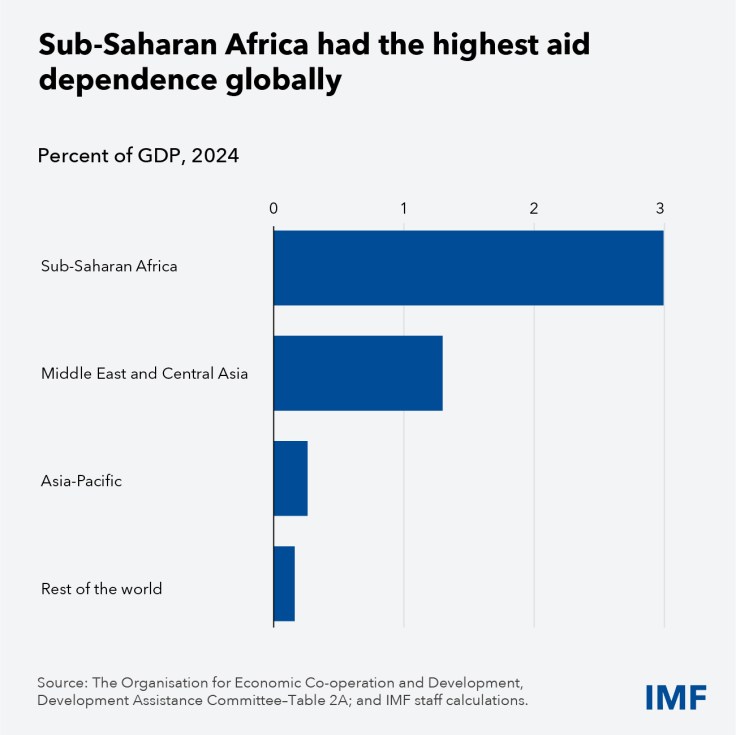
The West have decided that imperialism is passé, therefore this solution to an African problem will be unpopular at home and abroad. Yet, the rule that if the Europeans refrain from something then that thing is prohibited for the remainder of humanity has been and is to be broken repeatedly. Ready examples are available of countries that induce revulsion and protest due to their mode of government and national ambition. India and China have similar populations and although significantly smaller in size, have a single government that governs in a manner that the West consider undemocratic or repressively democratic. Despite bilateral aid to sub-Saharan Africa falling, Africa has the highest global aid dependency. When you are dependent on others, particularly financially, it is difficult to make your own decisions, especially decisions that your creditors do not agree with. This the reality that Africa must contend with. Great bravery of thought and action is required to transform this Africa and return her to an Edenic state.
Yet finally the direction of travel is clear.
References
(n.d.). Retrieved from https://education.nationalgeographic.org/resource/Continent/
Africa GDP 2023. (n.d.). Retrieved from https://countrycassette.com: https://countrycassette.com/africa-gdp-2022/
Ahillan, T. (2024, August). Fifth of medicines in Africa may be sub-par or fake, research finds. Retrieved from theguardian.com: https://www.theguardian.com/world/article/2024/aug/04/fifth-of-medicines-africa-substandard-fake-research
Joe Hasell, M. R.-O. (n.d.). Poverty. Retrieved from ourworldindata.org: https://ourworldindata.org/poverty
MINISTRY OF ENVIRONMENT, F. A. (2024, August 24). UPDATE ON THE CULLING OF WILD-ANIMALS AS A RESULT OF DROUGHT AND FATAL REPORT INVOLVING ELEPHANT. Retrieved from meft.gov.na: https://www.meft.gov.na/files/files/Culling%20of%20Wild-animals%20as%20a%20Result%20of%20Drought.pdf
Namibia declares state of emergency over drought. (n.d.). Retrieved from namibian.com: https://www.namibian.com.na/namibia-declares-state-of-emergency-over-drought/#:~:text=This%20declaration%20is%20detailed%20in,of%20Namibia%2C%E2%80%9D%20Mbumba%20says.
Number of living languages in Africa as of 2022, by country. (n.d.). Retrieved from statista.com: https://www.statista.com/statistics/1280625/number-of-living-languages-in-africa-by-country/
Over 20 million more people hungry in Africa’s “year of nutrition”. (2023). Retrieved from oxfam.org: https://www.oxfam.org/en/press-releases/over-20-million-more-people-hungry-africas-year-nutrition
REPORT, M. I. (2024, Jam). The power of Data for Governance . Retrieved from https://mo.ibrahim.foundation/sites/default/files/2024-01/2023-iiag-series-report.pdf
Samuel Kofi, T. B. (2024). Are the poorest countries being left behind? Retrieved from worldbank.org: https://blogs.worldbank.org/en/opendata/are-poorest-countries-being-left-behind
Shakespeare, W. (2008). The Tragedy of Antony and Cleopatra . Oxford : Oxford Univeristy Press.
THE 17 GOALS. (n.d.). Retrieved from sdgs.un.org: https://sdgs.un.org/goals
Where in the world do the poor live? It depends on how poverty is defined. (n.d.). Retrieved from worldbank.org: https://datatopics.worldbank.org/world-development-indicators/stories/where-do-the-poor-live.html#:~:text=However%2C%20the%20pace%20of%20poverty,(Sub%2DSaharan%20Africa).
Which Continent Is The Richest In Natural Resources? (n.d.). Retrieved from worldatlas.com: https://www.worldatlas.com/articles/which-continent-is-the-richest-in-natural-resources.html


Leave a Reply